
DeepSeek Model Comparison: V3 vs R1 – Performance, Cost, and Real-World Use Cases

Large language models keep getting better, but most teams don't need the biggest or priciest one available. Lately, DeepSeek has stood out as a practical choice for people who want solid reasoning without breaking the bank. Their models strike a nice balance between capability and affordability, making them popular among developers and businesses focused on tasks like math, coding, and logical problem-solving.
In this article, we look closely at two key DeepSeek models: DeepSeek V3 and DeepSeek R1. We'll break down how they compare on benchmarks, what each does best (and where they fall short), pricing realities, and everyday scenarios where one might fit better than the other. Everything here pulls from reliable public sources like ArtificialAnalysis.ai, Hugging Face model cards, and community evaluations.
A Quick Look at the Two Models
Both DeepSeek V3 and DeepSeek R1 use a Mixture-of-Experts (MoE) design—671 billion total parameters, but only around 37 billion active during any given task—which keeps things efficient. They also share a 128K context window, good for handling long documents or conversations.
The real split comes in focus and training:
- DeepSeek V3 is the general-purpose workhorse. It's built for a wide range of tasks, from everyday chat and content creation to coding and quick analysis. It delivers fast, direct answers without much extra overhead.
- DeepSeek R1 (released January 2025, with updates like R1-0528 in May) is the dedicated reasoning specialist. Trained heavily with reinforcement learning (RL) on top of the V3 base, it thinks step-by-step, explains its logic clearly, and tackles complex problems that require deep chain-of-thought processing. It often shows its full reasoning trace, which helps with transparency and debugging.
In short: V3 is about speed and versatility; R1 is about depth and accuracy on hard stuff.
How They Stack Up on Benchmarks
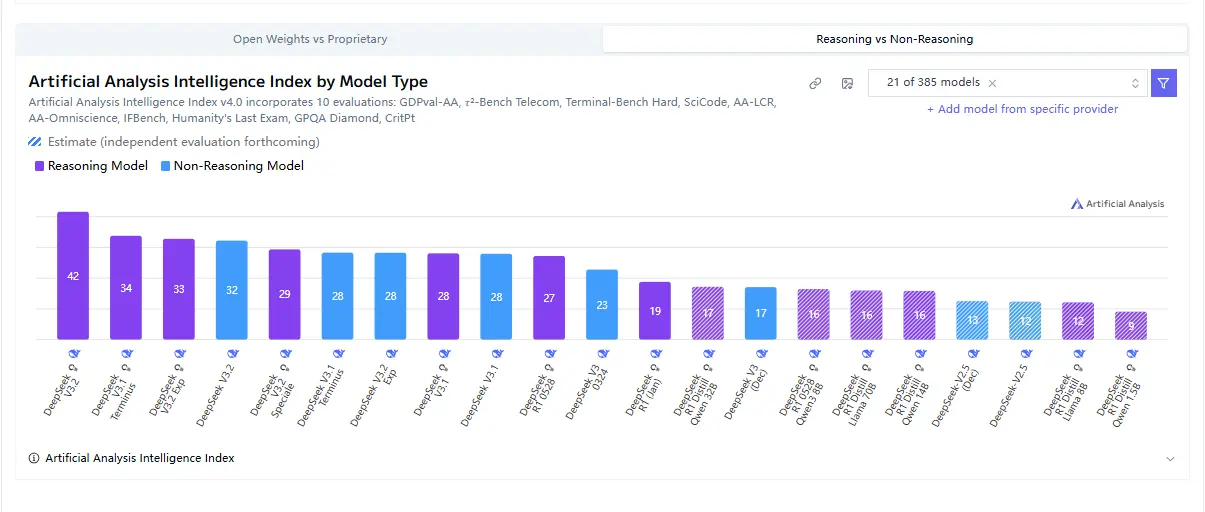
Independent tests from ArtificialAnalysis.ai and other leaderboards give a clear picture. (Note: Exact numbers can vary slightly by variant and evaluation date, but the trends hold steady.)
Reasoning & Math
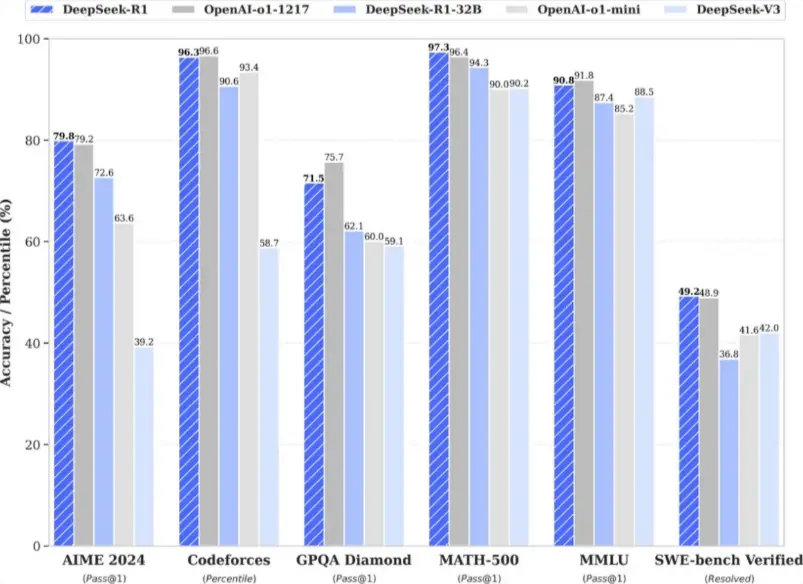
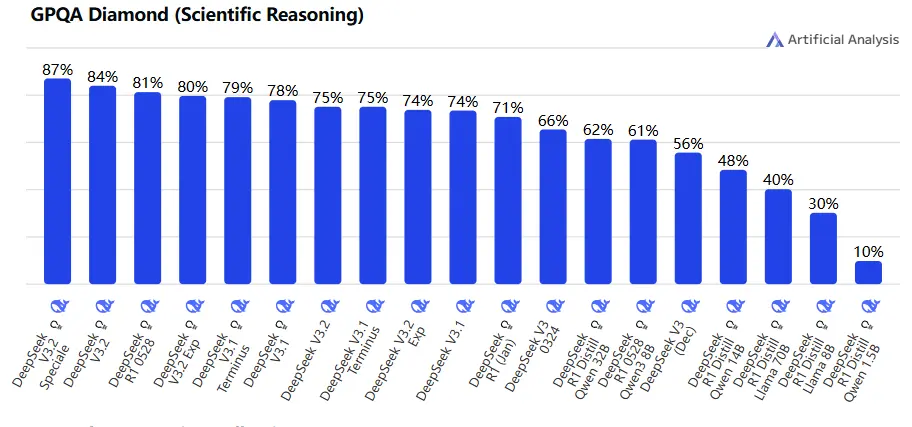
R1 pulls ahead here. On tough benchmarks like MATH-500, R1 hits around 97% pass@1 accuracy in strong variants, while V3 sits closer to 90%. For AIME-style math problems, R1 scores in the high 70-80% range, compared to V3's lower 30-40% on similar tests. GPQA (graduate-level reasoning) shows R1 gaining 5-10 points over V3 in many subsets.
R1's edge comes from its RL training—it learns to self-verify, reflect, and avoid shortcuts, so it stays consistent even on multi-step problems.
Coding & Technical Work
V3 is reliable for everyday coding: HumanEval scores hover in the mid-80s, with clean, functional output for general scripts, refactoring, and multi-language support.
R1 shines when code needs explanation or debugging. It traces logic better, catches edge cases, and generates more readable solutions for complicated tasks. In LiveCodeBench (real-world coding challenges), R1 variants often gain 5-10% over V3 baselines, especially in repo-level work or agentic coding.
General Tasks & Speed
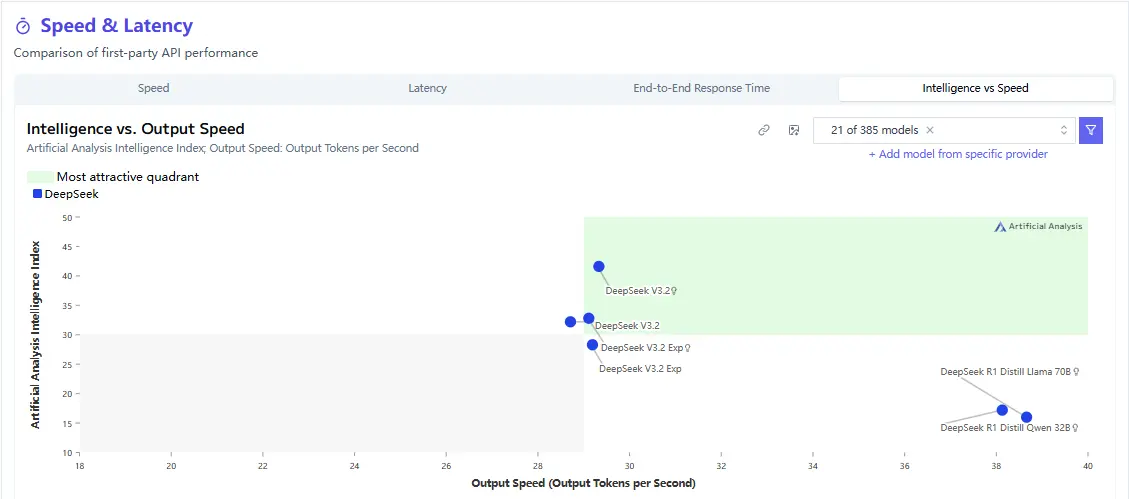
V3 feels snappier for simple prompts—fewer tokens wasted on unnecessary thinking steps, lower latency for chat or quick queries. R1 can take longer because it "thinks" more (showing chain-of-thought), but the output quality often justifies the wait for precision-critical work.
On cost: Both are very affordable via API (often under $1-3 per million tokens depending on provider), but R1's extra reasoning steps can use slightly more tokens on complex queries. The difference is small, and platforms like Siray.ai help optimize routing to keep expenses down.
Real-World Use Cases: When to Pick One Over the Other
DeepSeek R1 Fits Best When:
- You're solving complex math, science, or logic problems (e.g., financial modeling, risk analysis, academic research).
- You need transparent reasoning for auditing or compliance (legal reviews, policy simulation, explainable AI).
- Building agents that plan step-by-step or debug intricate code—R1's self-reflection reduces errors in long chains.
- Teams want to learn from the model's thought process (great for education or iterative problem-solving).
DeepSeek V3 Shines For:
- Everyday development: generating code snippets, refactoring, writing docs, or building chatbots.
- High-volume, fast-response apps where speed matters more than deep analysis (content creation, translation, customer support).
- General RAG setups or summarization—V3 handles quick retrieval and concise outputs efficiently.
- Budget-conscious projects needing broad coverage without overpaying for specialized reasoning.
Many teams mix both: Use V3 for routine work and switch to R1 when a task gets tricky. On Siray.ai, you can access either model through one unified API, with smart routing that picks the right one automatically based on your prompt.
Final Thoughts
DeepSeek V3 and R1 show how focused design beats brute force in many cases. V3 gives reliable, efficient performance across the board—great for most day-to-day needs. R1 takes things further with superior reasoning depth, making it the go-to for anything that demands careful logic or transparency.
Together, they make high-quality AI accessible without the huge bills of closed models. Whether you're prototyping, scaling production, or experimenting, the choice comes down to your priorities: speed and breadth (V3) or precision and insight (R1).
Ready to see the difference yourself?