
GPT-5.2 Codex Review: The New King of Agentic Engineering?

The landscape of AI-assisted development has just shifted tectonically. While 2024 was the year of the "chatbot coder," late 2025 marks the dawn of the "AI Software Engineer." OpenAI’s release of GPT-5.2 Codex isn't just an iteration; it is a fundamental reimagining of how artificial intelligence interacts with complex, real-world codebases.
For developers, technical leads, and security researchers who have been juggling context limits and hallucinated libraries, the wait is over. Today, we are diving deep into what makes this model a potential industry standard, how it stacks up against titans like Claude Opus 4.5, and why it might be the smartest addition to your workflow on Siray.AI.
The Shift from "Assistant" to "Agent"
To understand the significance of GPT-5.2 Codex, we must first look at the limitation of its predecessors. Previous models were fantastic at generating snippets—writing a Python function here, a React component there. But they struggled with persistence. If you asked an AI to refactor a legacy module spanning 50 files, it would often lose the thread, forget variable definitions, or hallucinate dependencies that didn't exist in your project.
GPT-5.2 Codex is explicitly designed for Agentic Coding. This means it doesn't just "reply" to a prompt; it plans, executes, and iterates on long-horizon tasks. It creates a mental map of your repository and maintains that "state" over thousands of lines of changes.
Under the Hood: Context Compaction & Vision
Two proprietary technologies drive this leap in performance: Context Compaction and Enhanced Vision.
Context Compaction is the game-changer for enterprise developers. In the past, feeding a massive documentation file or a 10,000-line log into a model would burn through your token limit and degrade reasoning quality. GPT-5.2 Codex utilizes a new "compaction" method that allows it to retain high-fidelity memory of the project's architecture without the computational overhead of raw context. This allows users on Siray.AI to upload entire repos and ask for architectural changes without the AI "forgetting" the core logic defined in utils.js three hours ago.
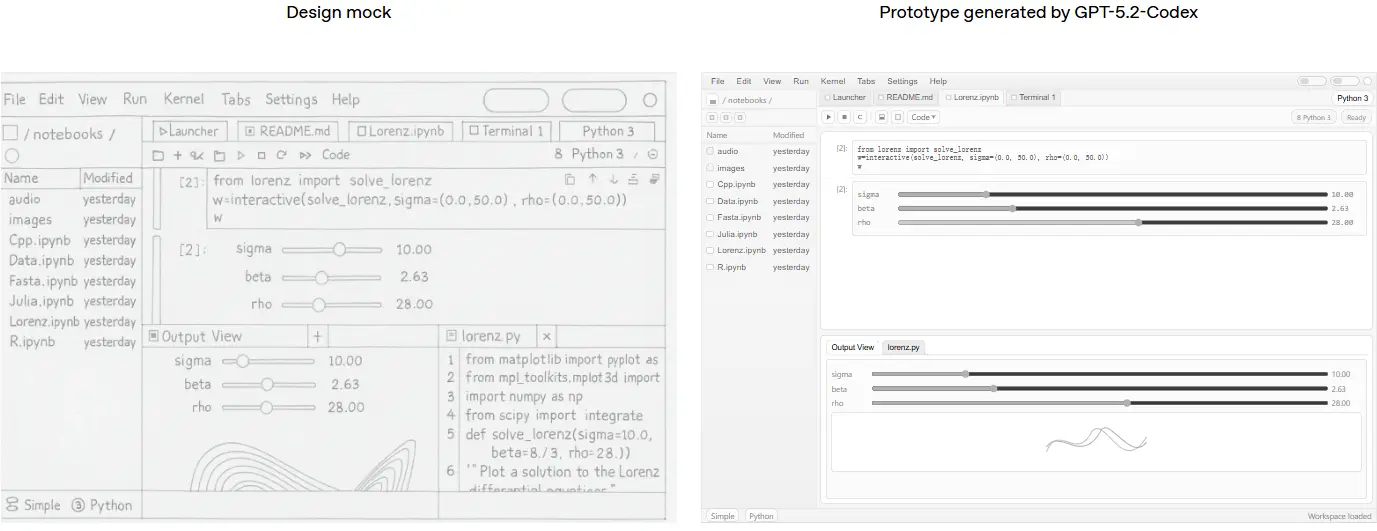
Secondly, the Vision Capabilities have been tuned specifically for software engineering. You can now drop a screenshot of a broken UI or a whiteboard diagram of a system architecture directly into the chat. The model doesn't just "see" the image; it understands the component hierarchy, the CSS implications, and the database schema implied by the drawing.
The Numbers: Benchmarking the Beast
In the world of AI, feelings don't matter—benchmarks do. And the numbers for GPT-5.2 Codex are staggering.
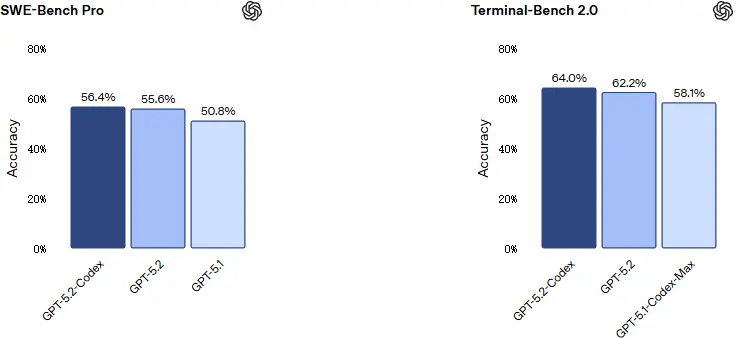
According to data validated by independent platforms like ArtificialAnalysis.ai, GPT-5.2 Codex has set new records on the industry's toughest evaluations:
- SWE-Bench Pro: The model achieved a score of 56.4%, a clear step up from the standard GPT-5.2 (55.6%) and a massive leap over the previous GPT-5.1 Codex-Max (50.8%). This benchmark measures the ability to solve real-world GitHub issues, not just toy problems.
- Terminal-Bench 2.0: This is where the "agentic" nature shines. Scoring 64.0%, GPT-5.2 Codex demonstrates an uncanny ability to navigate command-line interfaces, run tests, and debug its own errors.
While competitors like Claude Opus 4.5 remain formidable in creative writing and nuance, GPT-5.2 Codex has carved out a decisive lead in pure engineering rigor. It is less likely to produce "lazy" code and significantly more capable of self-correction.
For a live comparison of inference speeds and cost-per-token efficiency between these top-tier models, we recommend checking the live leaderboards atArtificialAnalysis.ai.
Cybersecurity: A "Sharp Jump" in Capability
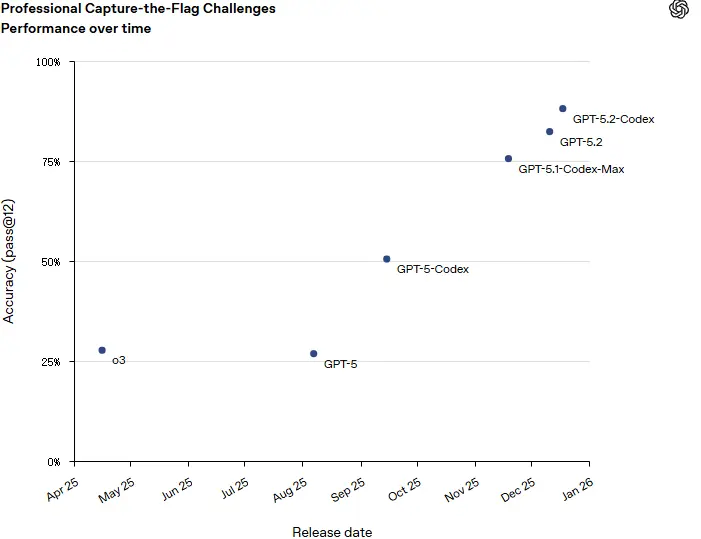
Perhaps the most controversial and impressive aspect of this release is its proficiency in Defensive Cybersecurity. OpenAI’s technical papers describe a "sharp jump" in the model's ability to analyze vulnerability patterns.
In early tests, the model was credited with assisting researchers in identifying the React2Shell vulnerability (CVE-2025-55182), a complex exploit vector that required understanding the interaction between frontend libraries and server-side shell execution.
For security professionals using Siray.AI, this opens up new workflows:
- Automated Audits: Upload a pull request and ask the model to specifically hunt for IDOR (Insecure Direct Object References) or SQL injection risks.
- Patch Generation: When a CVE is announced, GPT-5.2 Codex can autonomously draft patches for your specific codebase, taking into account your custom dependencies.
Note: While the model is powerful, it is designed with safeguards. It excels at defensive analysis but refuses requests to generate malicious exploit payloads.
Real-World Use Cases: Where it Shines
So, what does this mean for your daily work? Here are three scenarios where GPT-5.2 Codex outperforms anything we've seen before:
1. The "Big Bang" Refactor Migrating from JavaScript to TypeScript, or moving a legacy Java monolith to Rust, used to be a multi-month nightmare. With Context Compaction, you can task GPT-5.2 Codex with migrating file-by-file while maintaining type safety across the entire project scope. It remembers the interfaces defined in Module A while rewriting Module B.
2. From Screenshot to Ship Product managers often hand over high-fidelity Figma mocks or screenshots of a competitor's feature. Developers can now input these visuals into Siray.AI, selecting the GPT-5.2 Codex model, and receive a pixel-perfect, responsive React or Vue component in seconds. It handles the CSS Grid/Flexbox logic that often frustrates human devs.
3. Test-Driven Development (TDD) on Autopilot Write your test cases first, then unleash the model. Because of its high score on Terminal-Bench, GPT-5.2 Codex can iterate on the code until all your tests pass, effectively automating the "Red-Green-Refactor" cycle.
The Verdict
GPT-5.2 Codex is not just a "smarter" chatbot; it is a specialized tool for builders. It trades some of the conversational whimsy of generalist models for ruthless efficiency and engineering context. If you are serious about shipping code, this is the engine you want under the hood.
However, access to such a powerful model can often be gated behind expensive enterprise APIs or complex waitlists. This is where we come in.
Try GPT-5.2 Codex on Siray.AI
We believe the best way to understand the power of agentic coding is to experience it yourself. You shouldn't have to wait for an API key to modernize your stack.
Siray.AI has integrated GPT-5.2 Codex directly into our platform, available for you to use right now. Whether you are debugging a stubborn error or architecting a new microservice, our platform provides the interface you need to leverage this model's full potential.
Ready to code at the speed of thought?