
MiniMax H3 vs Wan 3.0: 4K Ceiling or Second-Level Control

The ceiling belongs to MiniMax H3 and the floor belongs to Wan 3.0. Which one that favours depends on whether your budget goes into the final frame or into the number of attempts before it.
Key Takeaways
- H3 tops out at 4K, Wan 3.0 at 1080p, and H3's 4K second is the cheaper of the two.
- Wan 3.0 gives seed and any duration from 2 to 30 seconds. H3 gives neither.
- Neither endpoint exposes negative_prompt.
What Each One Accepts
Field | minimax-h3-t2v | wan-3.0-t2v |
size | 768p / 2k / 4k | 480p / 720p / 1080p |
duration | Integers 5–15 | Integers 2–30 |
aspect_ratio | Required, six values incl. 21:9 | Required, six values incl. adaptive |
seed | Not present | -1 to 2147483647 |
prompt_expansion_enable | Not present | Optional, default true |
negative_prompt | Not present | Not present |
i2v aspect_ratio | Not present | Required |
ref2v inputs | 9 images, 9 videos, 9 audio | 10 images, 5 videos, 5 audio |
The Ceiling Is H3's, the Floor Is Wan's
H3 climbs two tiers past where Wan 3.0 stops. If the deliverable is a hero shot or anything that will be cropped, scaled or projected, 1080p is a hard wall on the Wan side and there is no parameter that gets you past it.
Wan 3.0 owns the other end. It has a 480p tier with no H3 equivalent, and its duration starts at 2 seconds where H3's starts at 5. Those two facts compound: the cheapest thing Wan 3.0 will render is a 2-second 480p clip, and H3 has no way to render anything that small.
What Each End Costs
Endpoint | Tier | List | Today |
minimax/minimax-h3-t2v | 768p | $0.08/s | $0.08/s |
minimax/minimax-h3-t2v | 2k | $0.13/s | $0.13/s |
minimax/minimax-h3-t2v | 4k | $0.16/s | $0.16/s |
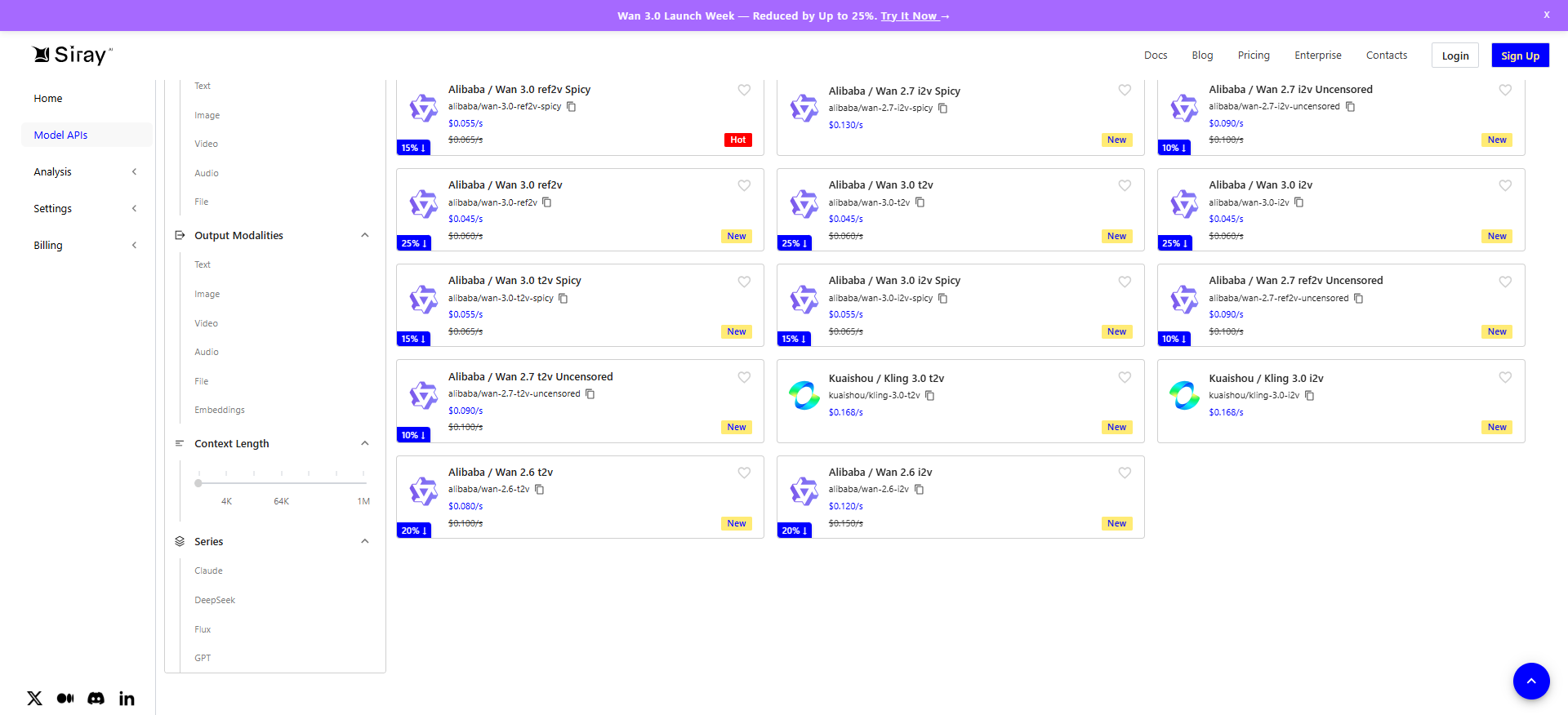
alibaba/wan-3.0-t2v | 480p | $0.060/s | $0.045/s |
alibaba/wan-3.0-t2v | 720p | $0.120/s | $0.090/s |
alibaba/wan-3.0-t2v | 1080p | $0.240/s | $0.180/s |
Two numbers fall out of that table. H3's highest tier bills about 11% less per second than Wan 3.0's highest, so the more detailed output is also the cheaper one. And the cheapest run each side will accept is $0.09 for Wan against $0.40 for H3, a 4.4x gap that lands entirely on iteration: forty test clips cost $3.60 on one side and $16.00 on the other.
The Wan column carries a Launch Week 25% off badge today and H3 carries no badge, so check the current rates rather than treating either column as permanent.
Where the Control Lives
Wan 3.0 gives you a seed, so a take you liked can be reproduced. H3 has no seed field, which means a good result is a good result once.
It also gives prompt_expansion_enable, defaulting to true. That default rewrites your prompt unless you turn it off, and the flag to turn it off has no H3 counterpart either way.Two more asymmetries worth knowing before you build:
- H3's image-to-video endpoint drops aspect_ratio entirely and takes shape from the input image. Wan 3.0 keeps it required on i2v, and adds an optional end_image.
- On reference-to-video, H3 includes five reference images in the base rate and bills each one past the fifth at $0.08/s for the length of the clip, so a 15-second job with nine references adds $1.20 per extra image. Wan 3.0's ref2v pricing table has no reference-image column at all.
FAQ
Does MiniMax H3 support negative prompts?
No, and neither does Wan 3.0. Neither endpoint exposes a negative_prompt field, so prompt phrasing is the only lever on both.
Which one is cheaper?
Neither across the board. Wan 3.0 is far cheaper to iterate with, at $0.09 per test run against $0.40, while H3's 4K second costs about 11% less than Wan 3.0's 1080p second.
Can Wan 3.0 output 4K?
No. Its size parameter accepts 480p, 720p and 1080p only. H3 accepts 768p, 2k and 4k.
Pick by the Job
Finishing work that has to hold up at full size goes to H3. Work where the cost that matters is the twentieth attempt, not the first, goes to Wan 3.0. Both run on Siray behind one API key and one bill, so the choice is per job rather than per account. Create your free Siray account and test both against the same prompt.