
Replicate Alternative: Comparing AI Media APIs on Price and Speed

Key Takeaways
- On LTX 2.3 video at matching 1080p resolution, Siray runs about 40% cheaper per second than Replicate's fast tier — but Replicate's version also offers 4K and native audio that Siray's endpoint doesn't.
- Z-Image pricing is close to parity between the two platforms; the real difference is Siray's flat per-image rate versus Replicate's per-megapixel scaling.
- Hunyuan Image 3 isn't a fair price comparison at all: Replicate only hosts the base generator, while Siray is the only one of the two offering the instruction-based edit variant.
Checking prices instead of guessing them
"Which API is cheaper" gets asked a lot, and it usually gets answered with numbers pulled from a blog post that's six months stale, or from a pricing aggregator that rounds everything to the nearest cent. Actual API pricing moves — providers add tiers, adjust rates by resolution, or ship a new model that quietly replaces the old one.
Video: LTX 2.3, matched at 1080p
Replicate hosts two LTX 2.3 tiers. At 1080p, ltx-2.3-fast runs $0.06 per second of output video, and ltx-2.3-pro runs $0.08 per second. Siray's LTX 2.3 endpoint is flat at $0.036 per second — noticeably cheaper at the same resolution.
That comparison needs one honest caveat. Replicate's fast and pro tiers also support 4K output, native audio generation, and video-editing features like extend and retake. Siray's LTX 2.3 endpoint is scoped to text-to-video and image-to-video only, at 720p or 1080p, 24 or 30 fps, 6 to 20 seconds — no 4K, no native audio, no extend or retake. The price gap is real, but so is the capability gap; if a project genuinely needs 4K or audio-synced output, Replicate's pro tier is doing more than Siray's endpoint does today.
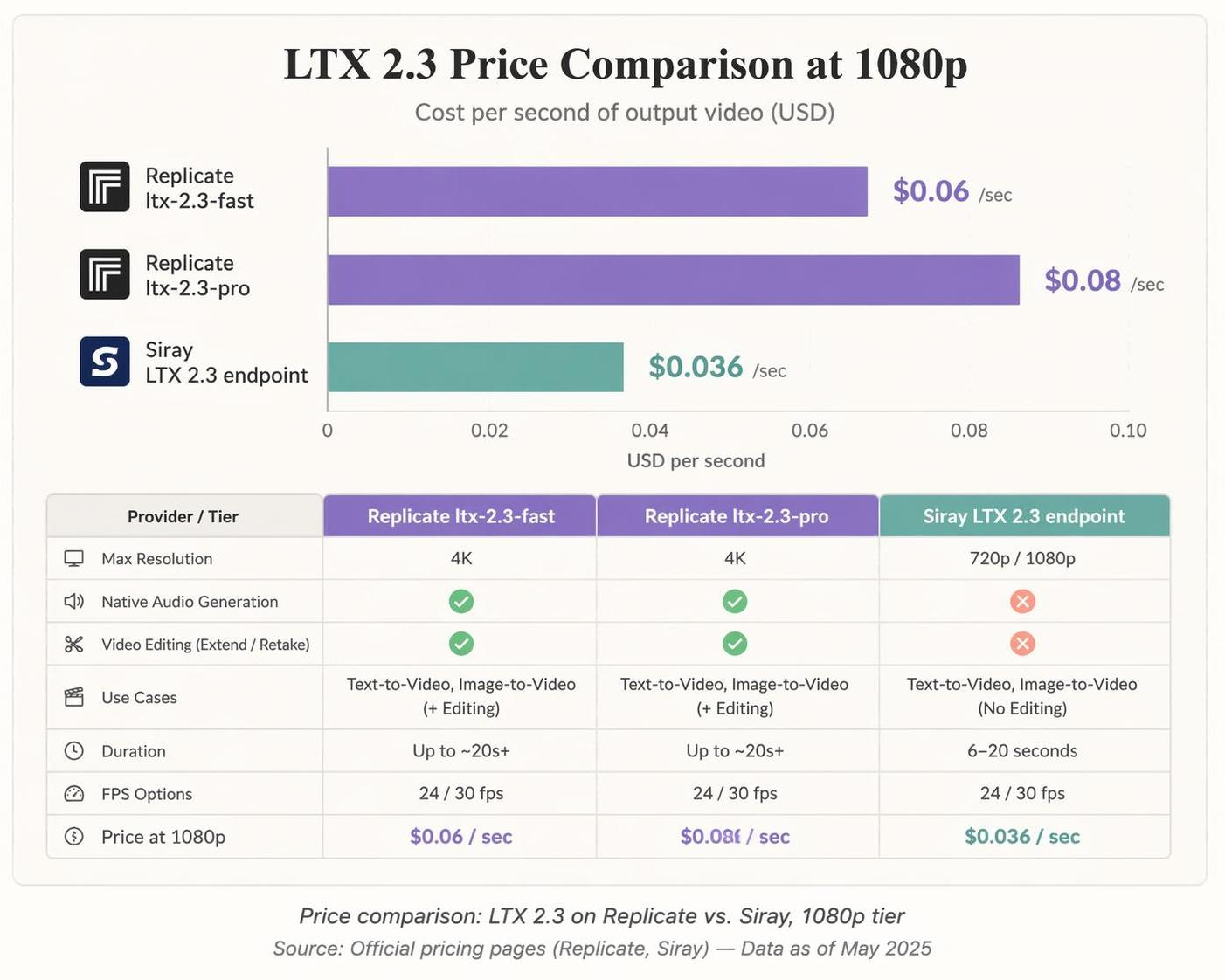
Image: Z-Image, close to a tie
Z-Image Turbo is priced by megapixel on Replicate: roughly $0.005 for a standard ~1-megapixel image, scaling upward at higher resolution tiers. Siray prices the same model at a flat $0.004 per image, regardless of resolution.
At typical output sizes, that's close enough to call a tie. The practical difference isn't the price — it's the pricing model. Siray's flat rate is easier to budget against; Replicate's per-megapixel scaling means a batch of larger renders costs proportionally more, which matters more for a high-resolution asset pipeline than for a one-off image.
Image: Hunyuan Image 3, not actually comparable
This is the one worth being upfront about. Replicate hosts a PrunaAI-optimized version of the base Hunyuan Image 3 text-to-image model at $0.08 per output image. Searching Replicate's own model catalog for an Instruct or edit variant of Hunyuan Image 3 turns up nothing.
So this isn't "Replicate is 20 cents cheaper for the same thing." It's two different capabilities: Replicate is cheaper if all a project needs is text-to-image generation from this model family. Siray is the only place between the two that offers the instruction-edit capability — changing an outfit, background, or pose in an existing image while holding the rest steady. Pretending these are interchangeable would be the kind of rounding error this article is trying to avoid.

One API key, three models
The practical case for consolidating onto one platform isn't just price — it's fewer integrations to maintain. Calling LTX 2.3 for video, Z-Image for fast image generation, and Hunyuan Image 3 Instruct for edits through Siray means one API key and one billing dashboard instead of three separate accounts, three sets of credentials, and three different pricing pages to keep re-checking.
Create your free Siray account and compare these prices against your own workload — the numbers above are current as of this writing, but pricing pages change, so always verify before committing a production budget.