
Seedance 2.5 Miniature Video: A City on Your Coffee Table

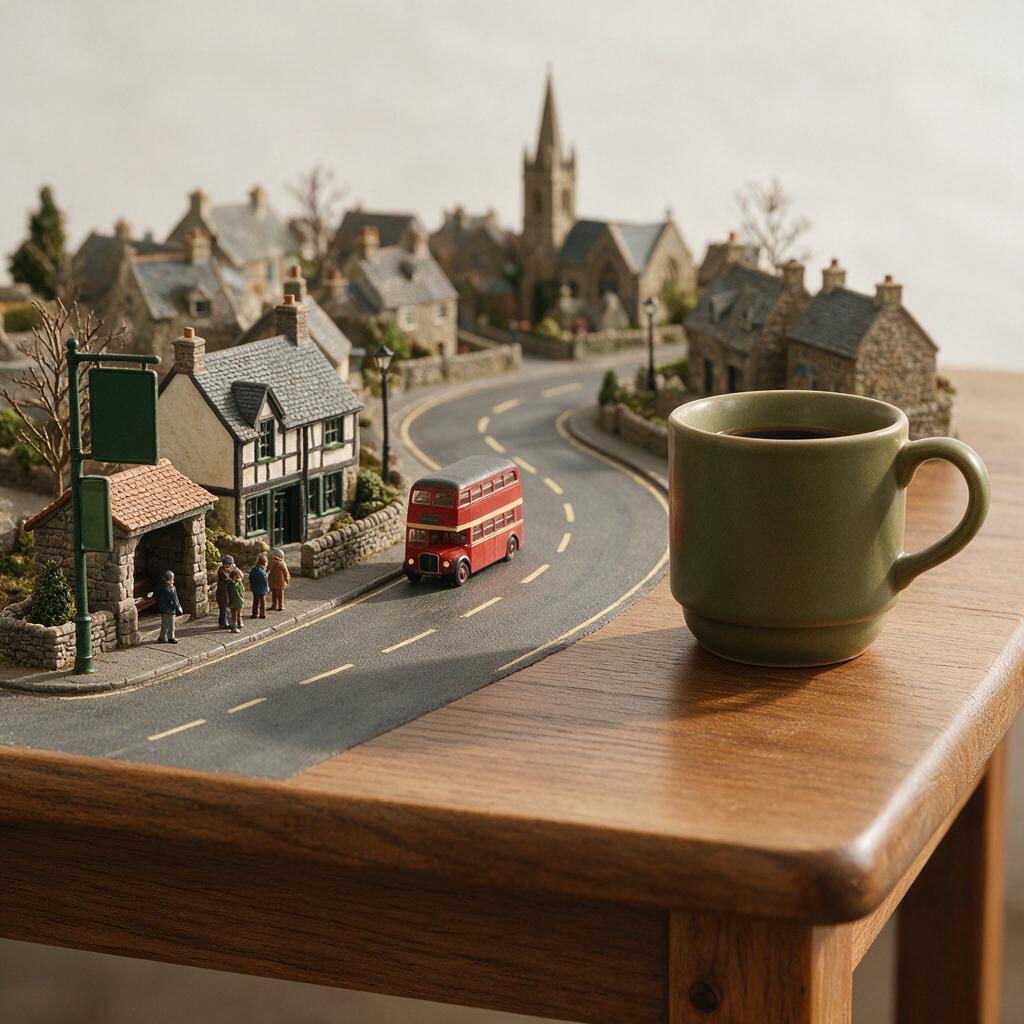
A tiny bus passing a full-sized coffee mug can sell a miniature city more clearly than a skyline covered in blur. For a Seedance 2.5 image-to-video concept, establish that size relationship in the starting image, then animate a readable slice of city life. The model has no miniature-world preset; the tabletop, layout and motion brief must explain the illusion.
Key TakeawaysBegin with a still that already contains the miniature city.Leave a familiar full-sized object visible as a scale reference.Give one moving vehicle a clear route before adding crowds.Check whether scale survives movement, not just the opening frame.
Build the City Before Asking It to Move
Prepare an authorised illustration, composite or photograph of a physical miniature scene. A bare tabletop does not establish where roads, buildings or vehicles belong. If the source needs compositing, finish that work first rather than treating the video prompt as a guaranteed scene-construction tool.
Arrange a small road beside a coffee mug, a cluster of low buildings and one bus. Let the mug tower above the buildings without blocking the route. Keep a strip of tabletop and part of its edge visible, so the viewer understands that the city sits on furniture rather than beside a giant building shaped like a cup.
Choose Scale Cues That Survive the Shot
Element | Role in the illusion | Failure to watch for |
|---|---|---|
Full-sized mug | Familiar size reference | Mug shrinks while bus approaches |
Wood grain and table edge | Reveal the supporting surface | Surface turns into ordinary terrain |
Tiny road and bus | Establish a local scale relationship | Wheels or road width change size |
Small figures | Suggest everyday activity | Figures grow into full-sized people |
Shallow depth of field can support the miniature look, but blur alone cannot establish size. Keep the bus route within the readable focus area. If everything except one roof is blurred, there is little useful action to watch.
Make One Route Carry the Busy Feeling
For the first clip, have the bus travel along one clear lane past the mug while a few pedestrians wait at a stop. This gives the city a purpose: a tiny commute. Extra windmills or crossing vehicles create competing movement, not necessarily more life.
Choose a locked camera for the first attempt. Camera travel introduces new surfaces and changing perspective that the source image does not show. Once a readable static-view clip exists, a separate experiment can explore a gentle camera move. Change that one variable rather than adding traffic, weather and a camera orbit together.
Request the Motion, Not a Miniature Mode
The Siray Seedance 2.5 i2v specification requires model, prompt, image, duration, size and aspect_ratio. It offers audio_enable and end_image, but no seed, prompt-expansion switch or miniature-scene field. An eight-second silent request is a starting choice, not a claim that the bus will finish its route at an exact second.
The Seedance brand explainer workflow deals with a shared look across separate scenes. This task stays inside one tabletop layout and asks whether its scale relationships survive animation. It does not need a montage to establish the idea.
Review the Middle, Not Only the Best Frame
Watch the bus relative to the mug throughout the clip. Does it stay on the road? Do buildings remain fixed while it passes? Does the table edge disappear? A strong first frame is not enough if the city becomes full-sized halfway through. Reduce motion or improve the source layout when the scale breaks.
Add traffic ambience later if it helps, using audio whose rights are clear. Keep it restrained: a giant engine roar can work against the small-world premise. Exact labels and titles belong in the edit. Do not call the result seamless or loopable unless its actual start and end have been checked. No video has been generated for this proposed example.
Create your free Siray account and give one tiny vehicle a route across your tabletop city.