
Vidu Q3 Pro Product Reveals: One Image or Two Frames?

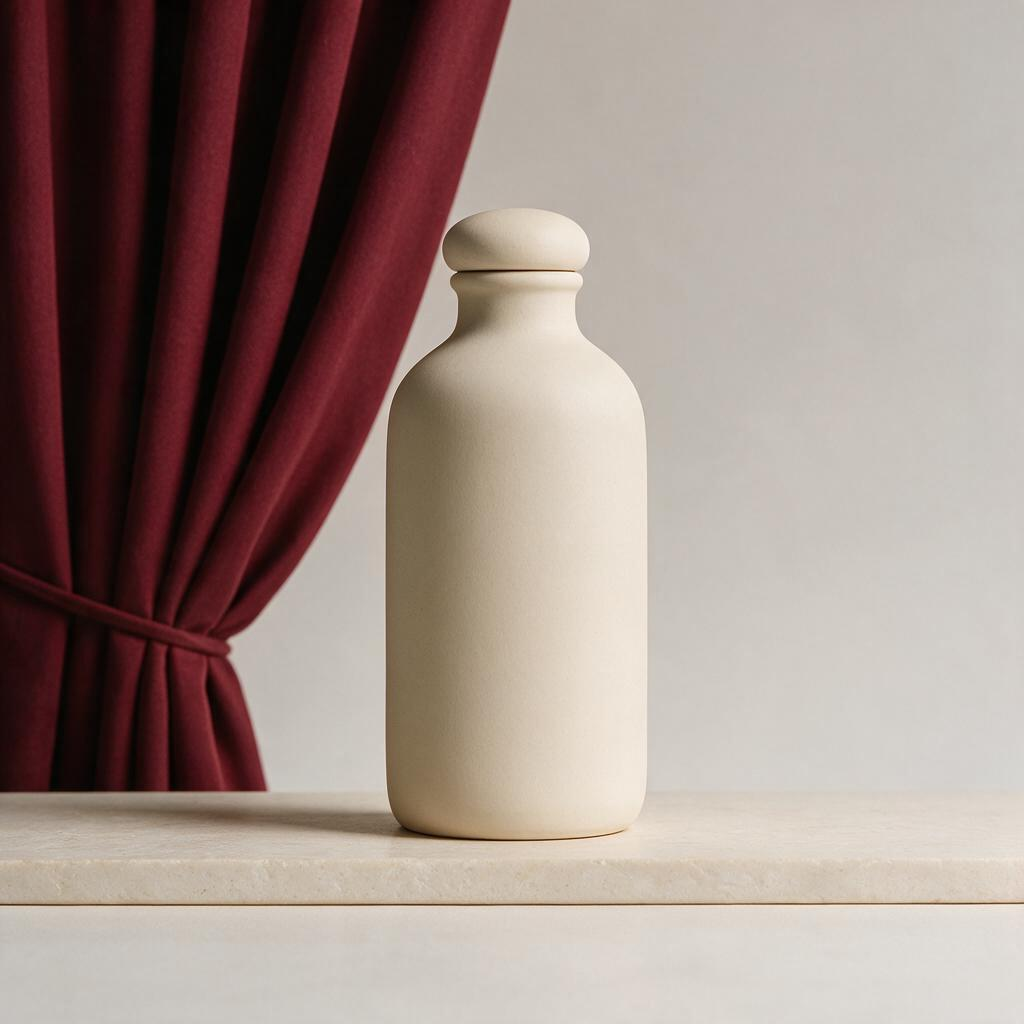
A product reveal does not have to start with a hidden product. With Vidu Q3 Pro, a safer creative brief is to reveal the presentation: move a foreground curtain aside while the product remains visible. Its image-to-video request accepts one image. A supplied start-and-end pair belongs to Vidu Q2 Pro's separate route, not Q3 Pro.
Key TakeawaysKeep the product visible in the source image when its shape must survive.Ask for one reveal action and a stable camera before adding complexity.Use Q2 Pro se2v when the shot needs two supplied endpoint images.Inspect the moving product, not just the attractive final frame.
Prepare an Image That Shows the Product
Use an authorised product photograph with a readable outline, consistent lighting, and space for the moving foreground element. A closed box gives the model no visual evidence of what is inside. Describing the product in text does not turn that hidden geometry into a reference.
For the example below, an unbranded ceramic bottle sits beside a curtain rather than behind it. The curtain movement changes the presentation while leaving the bottle available as visual evidence. This is a shot-design recommendation, not a guarantee that the model will preserve every surface detail.
Give Q3 Pro One Job
Start with a locked camera and a curtain sliding sideways. Avoid combining an opening box, rotating product, moving camera, and changing background in the first request. If the result fails, a single-action brief makes the failure easier to identify: did the curtain move incorrectly, or did the product itself deform?
The Siray Q3 Pro i2v specification, checked October 8, 2026, requires model, prompt, image, duration, size, and aspect_ratio. The example uses a supported four-second, 720p, 16:9 configuration. The schema does not expose end_image or a two-image images array.
When the Final Composition Is Non-Negotiable
A campaign may require a supplied final packshot, with the bottle in a particular position and enough empty space for later typography. That is a reason to test Q2 Pro se2v, which requires exactly two images and accepts four or eight seconds at 720p or 1080p. It has no aspect_ratio field.
Prepare the pair from the same setup: identical camera position, product scale, background, and lighting. Change the foreground arrangement rather than making the model reconcile two unrelated photographs. Supplying an end frame still does not guarantee accurate geometry throughout the transition. The Vidu generation guide explains the broader endpoint differences; this choice is about the shot's endpoint requirement.
Inspect the Reveal Before Adding the Headline
Moment | Inspection | Why it matters |
|---|---|---|
Opening | Bottle outline and initial curtain placement | Establishes what the source actually supplies |
Middle | Rim, handle or cap, reflections, curtain edge | A correct ending can hide intermediate deformation |
Ending | Product position and text-safe space | Determines whether the clip fits the planned layout |
Scrub the whole clip after checking those moments. Watch for a cap appearing twice, a reflection moving independently, or a curtain passing through the product. Reject these defects before adding music, titles, or a colour grade. Add precise brand lettering in post rather than treating generated lettering as an approved label.
Does a Two-Frame Route Guarantee a Better Reveal?
No. It adds a supplied endpoint, not proof of better motion. Try Q3 Pro for a restrained single-image reveal; test Q2 Pro when the final supplied composition is essential. No generated clips were available for this article, so neither route is presented as the measured winner.
Create your free Siray account and test the simple reveal before building the full product spot.