
AI Food Videos for Holiday Menus: Steam, Pour and Slow-Motion Prompts with Wan 3.0
Three tested Wan 3.0 prompts for restaurant and food-brand video: a cranberry sauce pour, a turkey-shaped charcuterie board and a steam close-up. Real timings, real caveats, $0.343 per clip during the Black Friday sale.
Wan 3.0 is Alibaba Cloud's video model that generates clips up to 30 seconds at 480p, 720p or 1080p, and it is available on Siray AI through one API. During the Black Friday sale a 5-second 720p clip costs $0.343 instead of $0.571. It suits food brands because it handles liquids, steam and slow camera moves without cutting.
Key takeaways
- Three prompts, three tested clips: 5 seconds each at 720p, $0.343 per clip during the sale that runs until December 1, 2026, 23:59 UTC.
- Every clip in this test finished in 103 to 107 seconds at 30 fps, 150 frames, H.264.
- The pour shot works best: sauce falls as a single coherent stream and the plate fills frame by frame. Prompt cleanly or a hand will drift into the top edge.
- The image-to-video endpoint returned 1284×716 with
aspect_ratio: adaptive, not the 1280×720 of the text-to-video clips. - Siray list price is $0.114 per second at 720p; the sale brings it to about $0.0685 per second, below Alibaba's published $0.10 per second for the same tier.
What is Wan 3.0?
Wan 3.0 is the current generation of Alibaba's Wan video family, published on Alibaba Cloud Model Studio on August 6, 2026. Alibaba's announcement lists a 30-second single-generation limit, resolutions of 480P, 720P and 1080P, and inputs that go beyond text and images: audio clips, reference videos and documents such as PPT, PDF or DOCX. It also offers video editing without regenerating the whole clip.
For a restaurant or a food brand, the practical parts are narrower. A 30-second pass is long enough for a whole menu sequence. Document input means a kitchen can hand over a menu PDF. Editing means a wrong garnish can be changed instead of reshot.
What Alibaba does not promise is physics. In our tests liquids stayed coherent and steam looked convincing, but framing drifts and small props move in ways a food stylist would notice. Treat these clips as B-roll, not as a replacement for a hero shot of the dish.
Endpoints on Siray AI
Wan 3.0 on Siray AI comes as nine endpoints. The -spicy and -prime-spicy variants relax content filtering; everything in this guide uses the standard endpoints and stays safe for work.
| Model ID | Mode | Main inputs | Notes |
|---|---|---|---|
alibaba/wan-3.0-t2v |
Text to video | prompt, duration, size, aspect_ratio | Cheapest path; 2 to 30 seconds |
alibaba/wan-3.0-i2v |
Image to video | same plus image, optional end_image |
Use aspect_ratio: adaptive with an input image |
alibaba/wan-3.0-ref2v |
Reference to video | up to 10 images, 5 videos, 5 audio clips | Input video seconds are billed on top |
alibaba/wan-3.0-t2v-spicy |
Text to video | as t2v | Unfiltered variant |
alibaba/wan-3.0-i2v-spicy |
Image to video | as i2v | Unfiltered variant |
alibaba/wan-3.0-ref2v-spicy |
Reference to video | as ref2v | Unfiltered variant |
alibaba/wan-3.0-t2v-prime-spicy |
Text to video | as t2v | 30% off list, not 40% |
alibaba/wan-3.0-i2v-prime-spicy |
Image to video | as i2v | 30% off list |
alibaba/wan-3.0-ref2v-prime-spicy |
Reference to video | as ref2v | 30% off list |
Shared parameters, from the Siray docs: duration accepts any integer from 2 to 30, size is 480p, 720p or 1080p, aspect_ratio is adaptive, 16:9, 9:16, 1:1, 4:3 or 3:4, and audio_enable turns the audio track on. prompt_expansion_enable defaults to true, so the model rewrites short prompts before generating.
Pricing on Siray AI
Prices below come from the Siray pricing API on November 26, 2026. Struck-through numbers are list price; the first number is what you pay during the Black Friday window.
| Duration | 480p | 720p | 1080p |
|---|---|---|---|
| 2 s | $0.069 |
$0.137 |
$0.274 |
| 5 s | $0.171 |
$0.343 |
$0.686 |
| 10 s | $0.343 |
$0.686 |
$1.371 |
| 30 s | $1.029 |
$2.057 |
$4.114 |
wan-3.0-i2v uses the same table. wan-3.0-ref2v adds $0.069 per input video second at 720p ($0.137 at 1080p). The -spicy endpoints run 40% off as well, and the -prime-spicy ones 30% off.
Worked examples:
- A holiday reel of 100 five-second 720p clips costs $34.30 during the sale, or $57.10 at list price.
- One 30-second 1080p hero video costs $4.114 now, $6.857 after December 1.
- Ten 5-second 720p variants of the same dish, to pick the best take, cost $3.43.
For context, Alibaba's own Model Studio pricing is $0.05, $0.10 and $0.20 per second for 480P, 720P and 1080P. Siray list price sits a little above that; the sale price sits a third below it. Both numbers are per output second, checked on November 26, 2026. Always confirm on the console model page before a large batch.
Requests submitted before December 1, 23:59 UTC are billed at the sale rate even if the render finishes later.
Quickstart: call Wan 3.0 with the Siray API
Submit a task, then poll it. The submit call returns a task_id; polling every few seconds until status is SUCCESS gives you the file in data.outputs.
curl -s https://api.siray.ai/v1/video/generations \
  -H "Authorization: Bearer $SIRAY_API_KEY" \
  -H "Content-Type: application/json" \
  -d '{
    "model": "alibaba/wan-3.0-t2v",
    "prompt": "Overhead shot of a turkey-shaped charcuterie board, slow steady push-in, warm tungsten light",
    "duration": 5,
    "size": "720p",
    "aspect_ratio": "16:9",
    "audio_enable": false
  }'
curl -s https://api.siray.ai/v1/video/generations/$TASK_ID \
  -H "Authorization: Bearer $SIRAY_API_KEY"
That is the exact request shape behind the three clips below, minus the prompt text. Keep the task ID: re-polling a finished task returns the same output URL and does not start a new render, which is how you avoid paying twice for the same clip.
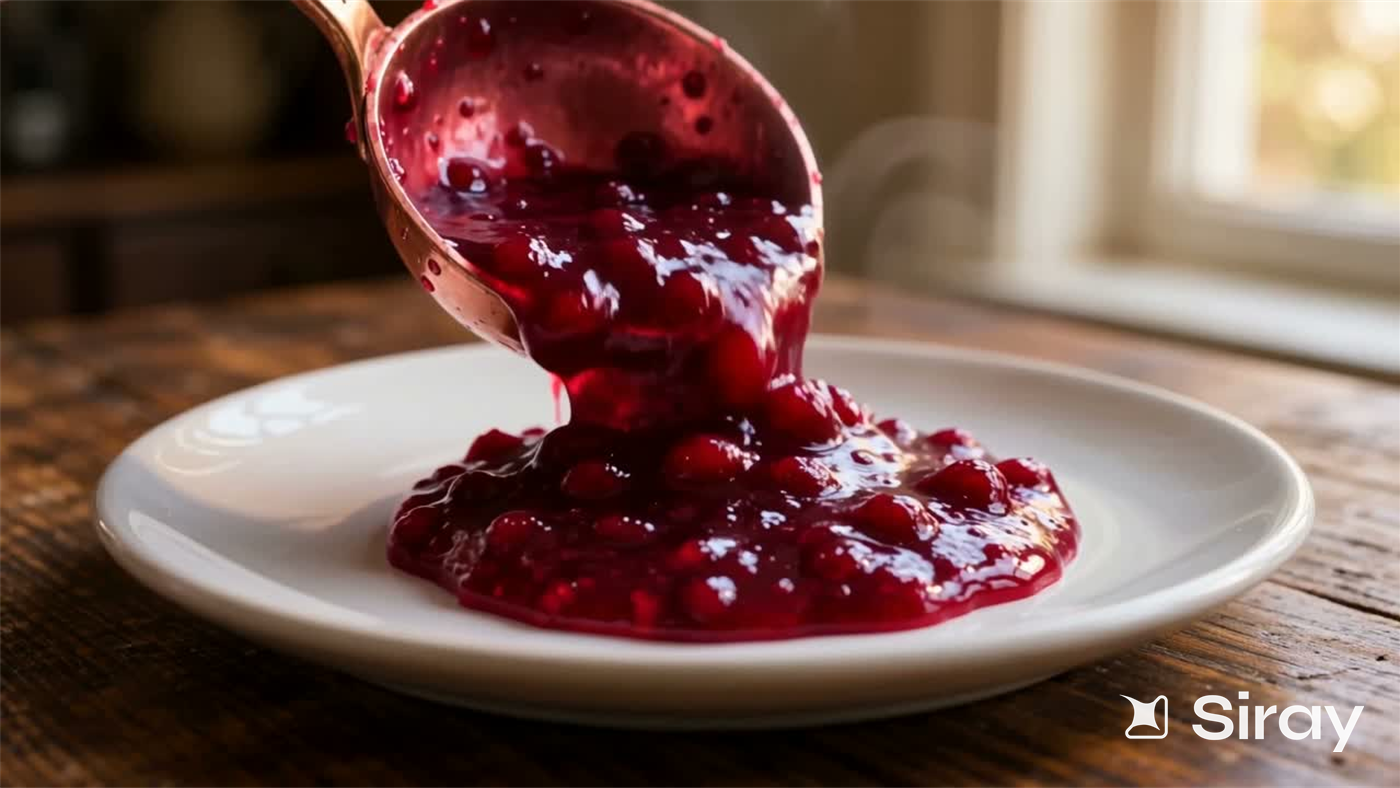
Illustration generated with Wan 3.0 on Siray AI, frame from the tested pour clip.
Prompt examples (tested)
All three clips: duration: 5, size: 720p, audio_enable: false, submitted from PowerShell with prompt_expansion_enable left at its default. Total spend for the test was $1.029.
Slow-motion cranberry sauce pour
Dramatic slow-motion macro shot of glossy cranberry sauce poured from a small copper ladle onto a white ceramic plate. Ribbons of sauce fold over themselves, droplets catching warm side light from a window, deep red highlights, dark walnut table, shallow depth of field, 120fps look played back slowly, natural handheld micro-movement. Only food and hands-free cookware are visible; no people, no faces, no text.
- Endpoint:
alibaba/wan-3.0-t2v, 5 s, 720p, 16:9 - Time: 103 seconds. Output: 1280×720, 30 fps, 150 frames, 4.61 MB. Cost: $0.343.
- Watch the clip
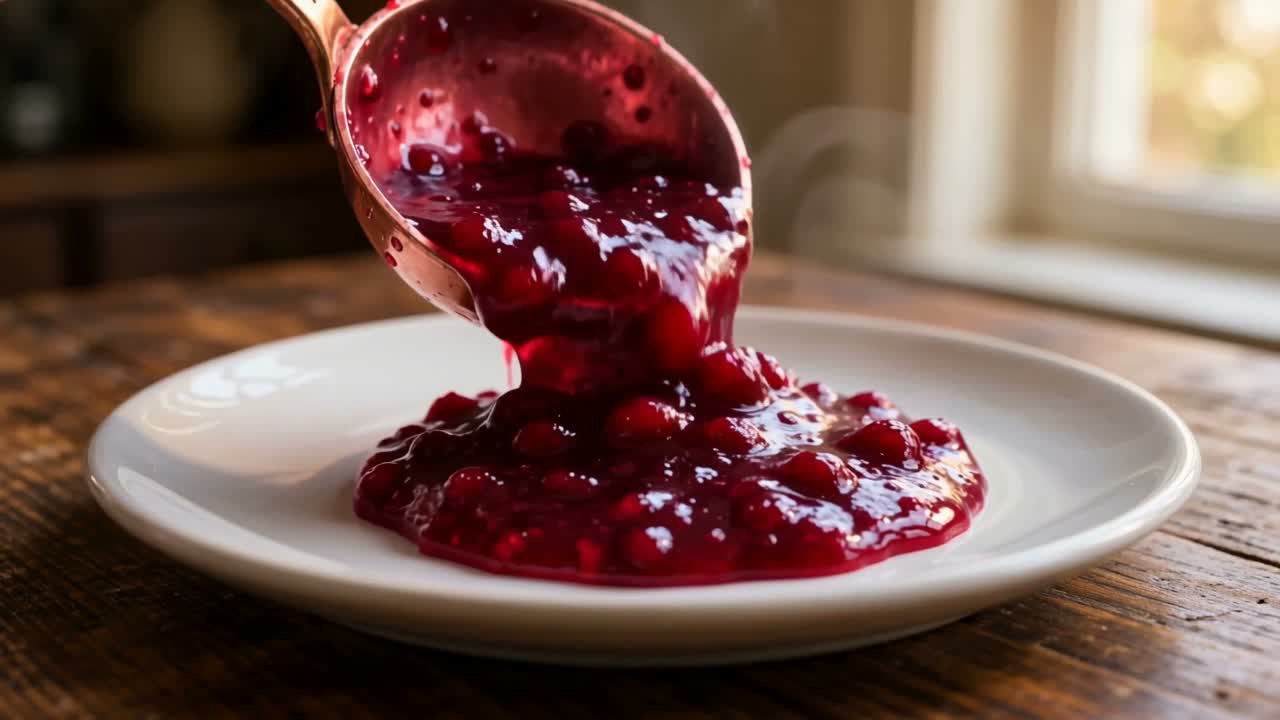
The strongest of the three. The sauce leaves the ladle as one coherent stream instead of breaking into separate droplets, and the plate fills progressively, so the 5 seconds have a beginning and an end. Two things to know. First, even with "no people" in the prompt, a hand holding the ladle drifts into the top-left corner during the first second; it is gone by mid-clip as the framing settles. Second, the camera loosens slightly as the plate fills, which reads as a natural move here and would be a continuity break in a longer edit. For a clean frame, crop the top 5% or start the clip at 0.5 seconds.
Turkey-shaped charcuterie board, slow push-in
Overhead shot of a turkey-shaped charcuterie board: thinly sliced cured meat fanned into tail feathers, cheese cubes and crackers arranged as the body, rosemary sprigs and fresh cranberries as garnish. Warm tungsten light, slow steady push-in toward the board, soft falloff at the edges, rustic wooden table. No people, no faces, no text, no packaging or brand labels.
- Endpoint:
alibaba/wan-3.0-t2v, 5 s, 720p, 16:9 - Time: 103 seconds. Output: 1280×720, 30 fps, 150 frames, 7.04 MB. Cost: $0.343.
- Watch the clip
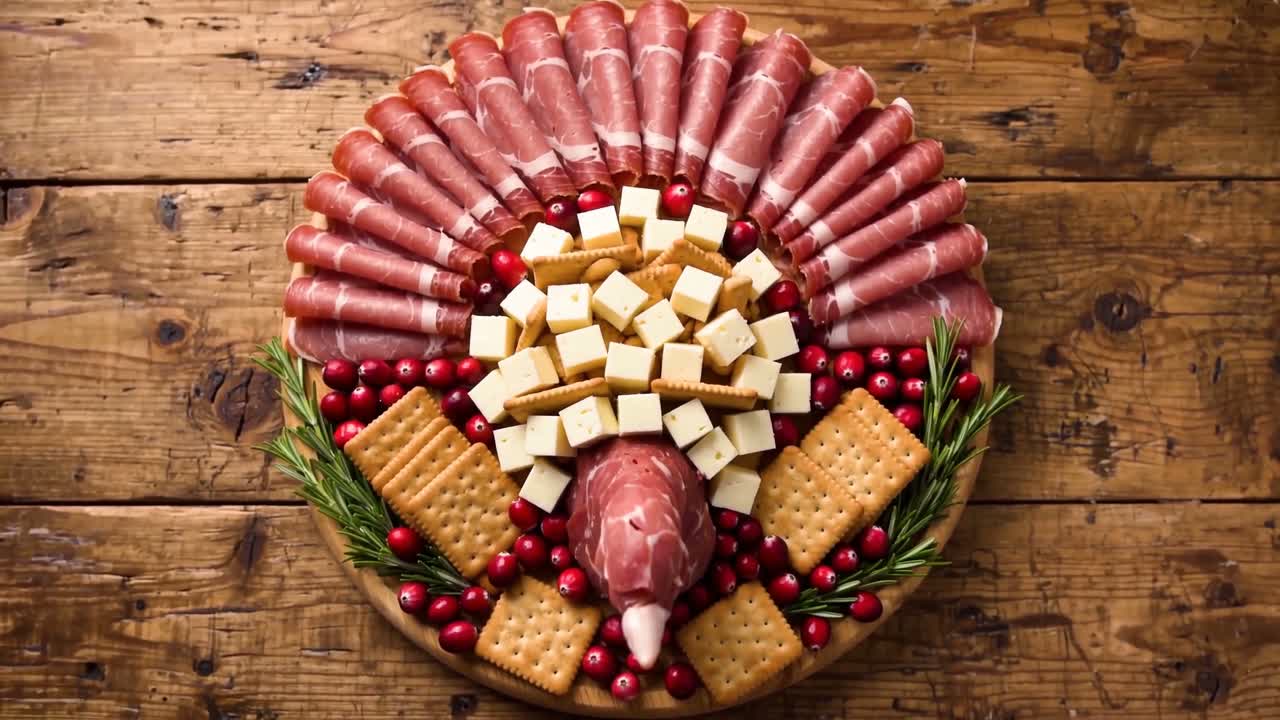
The silhouette reads as a turkey immediately, which is the hard part: the fanned meat becomes tail feathers and the crackers and cheese fill the body. Two caveats. The push-in is gentle. Comparing the first and last frames, the board grows only slightly, so at 5 seconds it reads as a slow drift rather than a move; ask for a faster push-in or accept it as a calm loop. And the model added a piece of meat at the bottom edge that looks like a head before we asked for one, which is charming here but worth checking on other subjects.
Steam close-up from a still photo (image to video)
Steam rises gently from sliced roast meat arranged on a ceramic platter. A slow rack focus moves from the front slice to the herbs behind it; warm backlight through a kitchen window, camera locked off, subtle steam drift, macro lens, shallow depth of field. No people, no faces, no text.
- Endpoint:
alibaba/wan-3.0-i2v, 5 s, 720p,aspect_ratio: adaptive - Input still: generated with Nano Banana Pro on Siray AI, $0.098
- Time: 107 seconds. Output: 1284×716, 30 fps, 150 frames, 7.66 MB. Cost: $0.343.
- Watch the clip
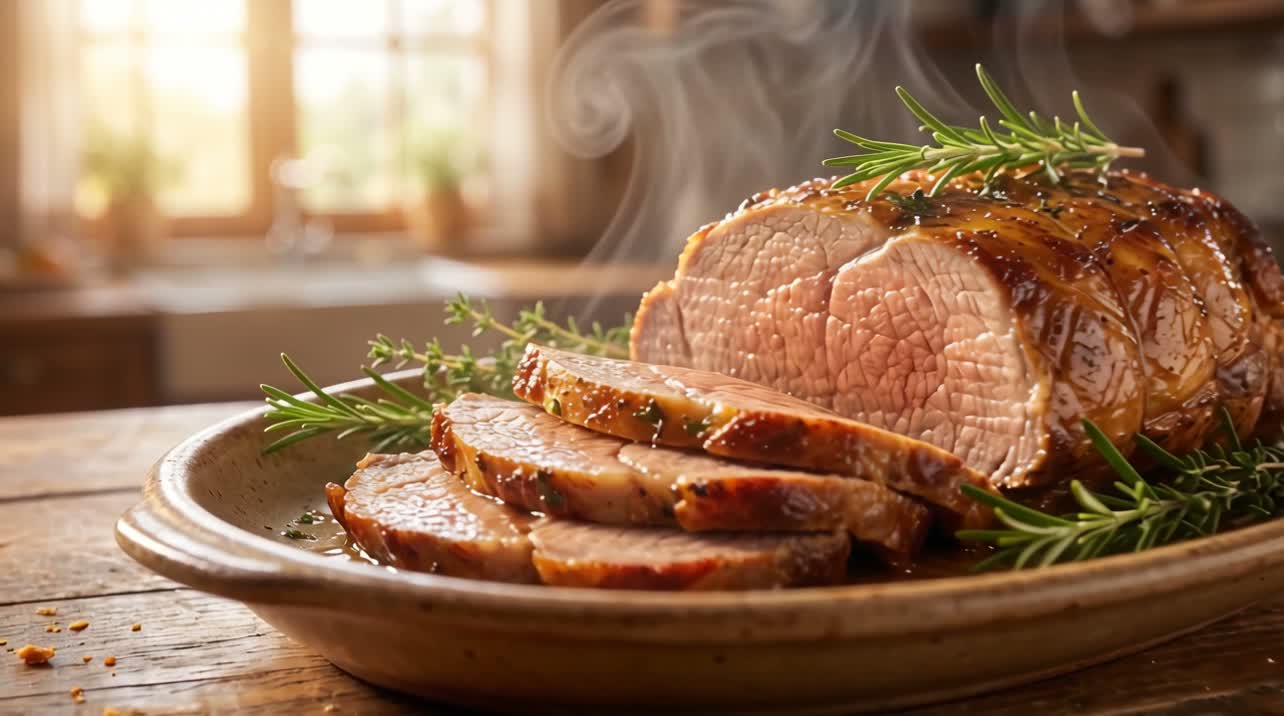
This is the workflow most restaurants already have: one good photo, one short animation for the menu page. The rack focus works exactly as prompted. The front slices are sharp at 2.5 seconds and the herbs behind are sharp by 4.8 seconds, with the steam drifting throughout. The cost is drift: the camera slides right as the focus pulls, and by the last frame the roast has moved to the edge. Set aspect_ratio: adaptive and expect the output size to follow the input, which gave us 1284×716 rather than 1280×720. If exact dimensions matter, crop after download.
Prompting tips
- Name the physical behaviour, not the mood. "Ribbons of sauce fold over themselves" produced better liquid motion than "delicious" or "appetizing" would. Wan 3.0 responds to verbs.
- Put the camera instruction last and make it small. "Slow steady push-in" worked; combining it with a second camera cue, such as orbit plus dolly, tends to produce a compromise drift.
- Say what must not appear, in the prompt. "No people, no faces, no text, no packaging or brand labels" kept labels and faces out, though a hand still slipped in at the frame edge. For strict no-hands shots, generate wide and crop.
- Use 5 seconds before you scale. A 5-second 720p clip costs $0.343 and renders in under two minutes. Lock the composition there, then render 10 or 30 seconds once, instead of paying for a long take you will reshoot.
- Leave
prompt_expansion_enableon for exploratory work, turn it off for repeatable batches. It rewrites short prompts, which helps when you are exploring and hurts when you need take-for-take consistency.
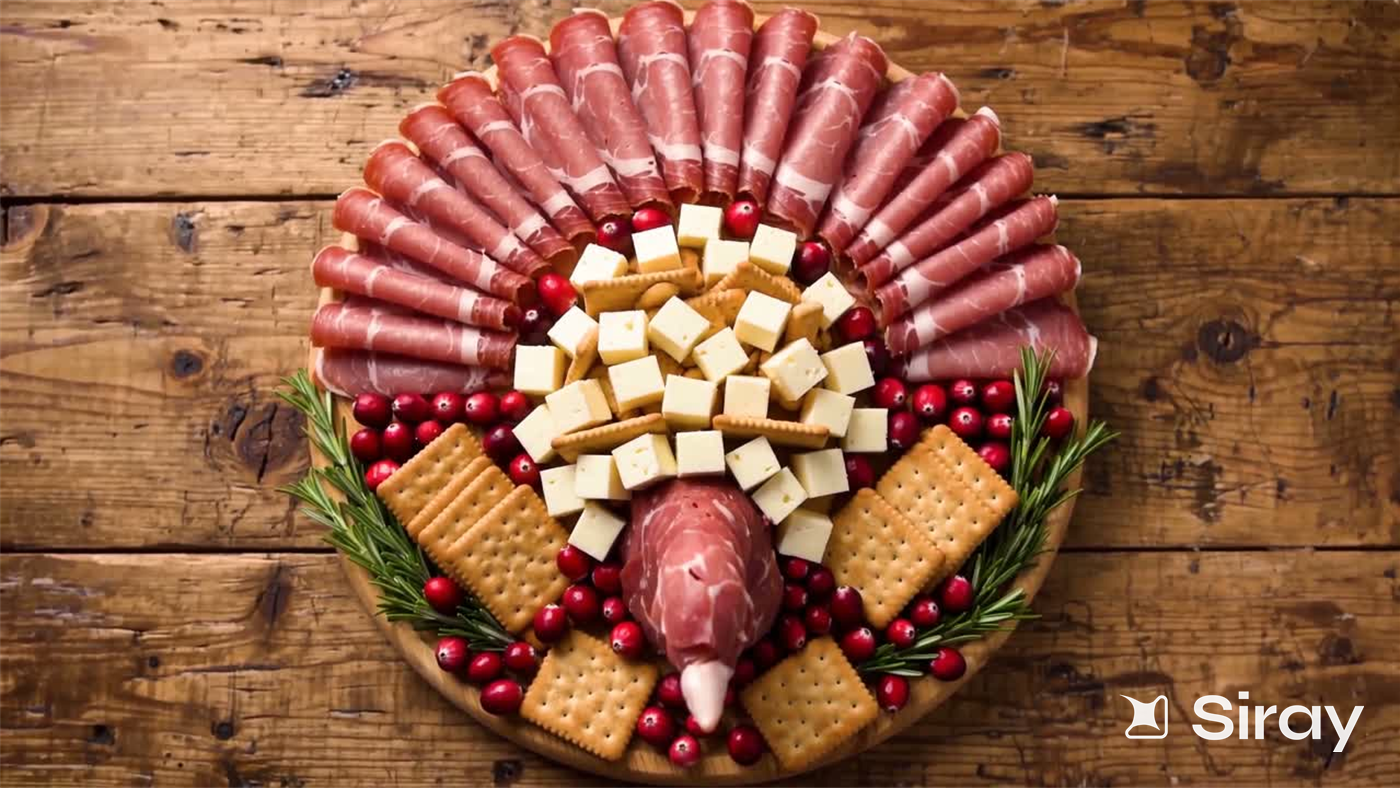
Illustration generated with Wan 3.0 on Siray AI, first frame of the tested board clip.
When to use Wan 3.0 (and when not to)
Use it when the shot has motion you can describe: pouring, steam, a slow push, a table reveal, a 30-second menu sequence. Use the image-to-video endpoint when you already have dish photography and want a few seconds of movement for a menu page or a delivery listing.
Skip it when you need exact product packaging, readable labels or a spoken script. Text rendering is not what this model is for, and dialogue belongs to a model with verified audio. For 9:16 social ads driven by one hero product photo, Seedance 2.5 is the more predictable choice in our tests (Black Friday video ads with Seedance 2.5). For per-model price comparisons across 14 video models, see what 100 AI product videos cost. If you are comparing generations rather than writing prompts, start with Alibaba's 30-second model explained.
FAQ
How much does Wan 3.0 cost on Siray AI?
A 5-second 720p clip costs $0.343 during the Black Friday sale (list $0.571), and a 30-second 1080p clip costs $4.114. Prices were checked on November 26, 2026, and the sale runs until December 1, 23:59 UTC.
Does Wan 3.0 support image-to-video?
Yes. alibaba/wan-3.0-i2v takes an image and an optional end_image for a first-and-last-frame transition. Use aspect_ratio: adaptive, because the output follows the input image.
How long can a Wan 3.0 clip be?
Up to 30 seconds in a single generation. duration accepts any integer from 2 to 30; 5 and 10 seconds are the practical sizes for social video.
How long does a 5-second clip take to render?
In our test, 103 to 107 seconds for a 5-second 720p clip at 30 fps. Plan on roughly two minutes per clip and poll every few seconds rather than blocking.
Can Wan 3.0 generate audio?
The API has an audio_enable field. Every clip in this guide was rendered with audio off, so we have not evaluated the quality of the generated track; leave it off and add music in your editor until you have tested it yourself.
Is Wan 3.0 good for food video?
For steam, pours and slow camera moves, yes. Our pour and steam clips held together without artifacts. Expect framing drift over 5 seconds and a hand occasionally entering the frame edge, and plan a short crop.
Ready to try it? Open Wan 3.0 on the Siray console, submit your first 5-second clip, and scale up once the composition holds.
Sources
- Alibaba Cloud Model Studio, "Wan3.0: 30-Second AI Video Generation from Any Input", August 6, 2026: https://modelstudio.alibabacloud.com/intl/blog/wan3-ai-video-generation-model/
- Siray API docs, Wan 3.0 t2v: https://docs.siray.ai/api-reference/model-api/wan-3.0-t2v
- Siray API docs, Wan 3.0 i2v: https://docs.siray.ai/api-reference/model-api/wan-3.0-i2v
- Siray API docs, Wan 3.0 ref2v: https://docs.siray.ai/api-reference/model-api/wan-3.0-ref2v
- Siray pricing API, full catalog and Wan 3.0 detail pages, retrieved November 26, 2026