
MiniMax H3 for Explainer and Product Onboarding Video

Key TakeawaysThe 5–15 second clip window maps almost exactly onto one onboarding step per clip, with Extend reaching roughly 30 seconds when a step needs more room.H3 is the rare video endpoint with a genuinely flat rate: $0.26 per second at 2K, independent of resolution — which makes a multi-step series budgetable before a single call is made.Native stereo audio means the narration bed and the visuals arrive from the same request instead of being assembled separately.
Explainer and onboarding video is the highest-volume video category inside most product organizations, and the least glamorous. Every pricing change, renamed menu, or new setup step invalidates a clip. Teams end up choosing between a stale library and a re-shoot budget nobody approved.
MiniMax H3 is available through Siray as minimax/minimax-h3-t2v, -i2v, and -ref2v. Its specific combination of properties — short native clips, a flat rate, and audio in the same response — lines up unusually well with this category. A full capability overview sits in the MiniMax H3 introduction.
The 5–15 Second Window Is the Right Unit
H3 generates 5 to 15 seconds natively at 24fps, and Extend pushes a clip to roughly 30 seconds. That range looks limiting until it is measured against how onboarding content is actually consumed: one step, one clip.
Building a series as discrete 8–12 second segments rather than one continuous three-minute video has a practical consequence. When step four changes, step four gets regenerated. Nothing else in the series is touched, and no re-render of a long timeline is required.
2K Output, and What It Is Not For
H3 renders at 2K, which matters for this category more than for most. Explainer video is frequently watched full-screen on a desktop monitor while the viewer follows along in the actual product, and soft output is more noticeable in that context than in a feed.
One boundary is worth stating plainly, and the FAQ below covers it: H3 is not a screen recorder. Capture the literal UI with one, and use H3 for everything wrapped around it. Motion phrasing for those shots is covered in the MiniMax H3 prompt guide.
Native Stereo as a Narration Bed
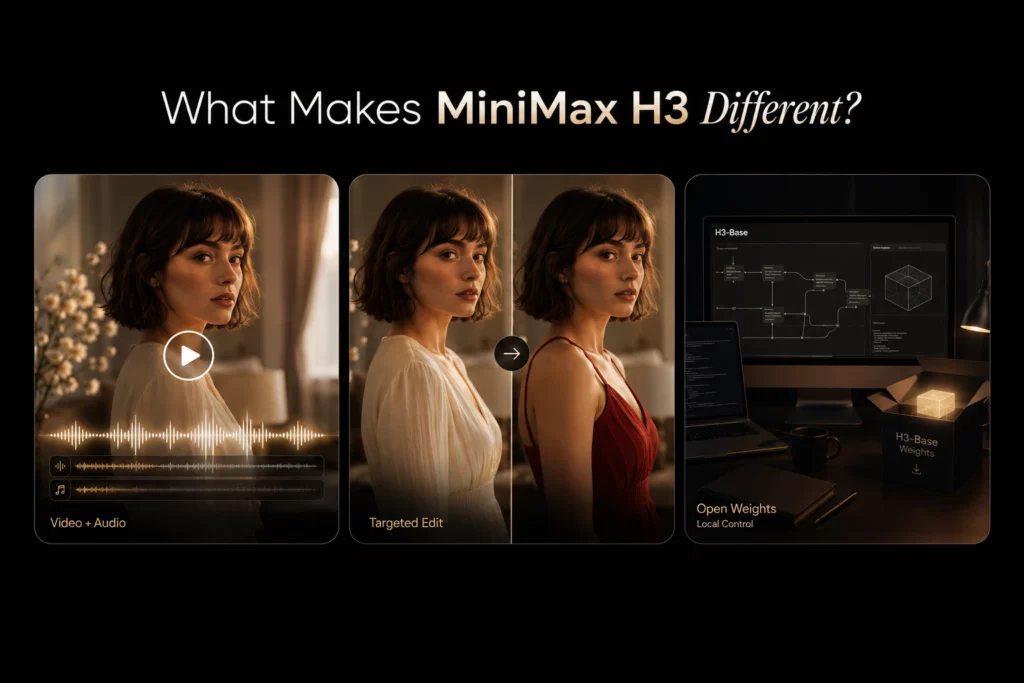
H3 produces original stereo audio natively, and the ref2v variant accepts reference audio alongside reference images and video. For onboarding work this removes a step: the ambient bed arrives with the footage rather than being sourced and mixed afterward.
Budgeting a Full Series
Most video endpoints charge a resolution-dependent rate, so per-second math has to be recomputed for every quality decision. H3 does not — its rate is flat, and the figures are in the FAQ below.That predictability is the actual argument for this model in this category. A series can be scoped, approved, and revised without a pricing conversation each time.
One Constraint to Plan For
H3 is a general-purpose endpoint with content moderation in place, well suited to product, brand, and instructional work — which is the whole of this use case. For adjacent applications of the same model, see the e-commerce and game UI motion write-ups.
FAQ
How much does a MiniMax H3 onboarding series cost?
H3 is priced at $0.26 per second at 2K, and that figure does not move with resolution. A six-step series at 10 seconds per step is 60 seconds of output, or $15.60. Adding a seventh step costs $2.60. The ref2v variant adds $0.08 for each reference image beyond the first five.
Can MiniMax H3 replace a screen recorder for product UI?
No. A generative video model is not a screen recorder, and text rendered inside a generated frame should not be treated as a substitute for a real capture of the interface. The productive split is to capture the literal UI with a screen recorder and use H3 for the context shots, transitional scenes, and human framing around it.
Does MiniMax H3 generate audio?
Yes. H3 produces original stereo audio natively, and the ref2v variant accepts reference audio alongside reference images and video. The ambient bed arrives with the footage; voiceover is still recorded separately.
Is MiniMax H3 an unrestricted endpoint?
No. H3 is a general-purpose endpoint with content moderation in place. It is well suited to product, brand, and instructional work, but it should not be selected on the assumption that it behaves like an unrestricted endpoint.
Create your free Siray account and call the MiniMax H3 t2v, i2v, and ref2v endpoints with one API key.